
An important idea in a series of measurements is the persistence of the conditions in which each measurement was made. Most weather stations do not change hardware or location during their lifespans. Still, changes over time and in the environment can require sensor recalibration, whether it occurs or not. Ultimately, the ability to trust a record of observations from a given station depends on the sensitivity of your workflow to the evolving characteristics of that station.
Key point: Within the Synoptic surface observation platform, a single platform series of observations will be stored in a single inventory without regard to any condition variations experienced by that station. It is the responsibility of the provider of a given station to define when a station record begins and ends.
How does Synoptic make condition changes usable
For any station that persists across condition changes, Synoptic keeps a complete log of its location, name, status and calibration histories, with timestamps of each change in the Synoptic platform.
The full history displays in the viewer station history interface and can be retrieved from the Weather API Metadata service using the stationhistory argument. This returns our inventory of changes and corrections as a list of parameters changed with their dates.
You may need to implement your own procedures to use this information to make informed decisions about an observation's usability. We do not have specific guidance on strategies to interpret a station history inventory to avoid using stations which may not meet your specific criteria.
How do Synoptic’s products handle these changes?
In general, Synoptics Weather API, viewer, download tool, and other data products do not consider station history changes when giving access to data.
Synoptic’s derived precipitation service will not integrate precipitation amounts across a DATA_AFFECTED change.
When you request data for a historical moment, the metadata included in the response will be the current metadata for the site. Location queries in historical periods will be based on present locations - meaning data received in a historical time may not be in the region you requested.
Will this change?
Yes, it is in our plans to address both the change-spanning data lookups performance, and the rendering of anachronistic metadata for platforms in historical requests. We are not currently able to give a timeline for this change.
Provider metadata (condition) change mechanisms
There are four general ways providers can handle station changes (particularly location changes)
New station for each move
This is the most robust procedure for handling condition changes for platforms. A single station in multiple locations is two stations. While this is the gold standard, it is very rare among providers.
For example, the Oklahoma Mesonet does not allow a single station series to represent a station that has changed physical location. If a station moves, the Mesonet defines a new station and marks the prior station inactive.
Individual station persists through many moves
The persistence of a single Synoptic station identity may be intended to serve something other than maximizing the historical usability of a dataset. In these cases, a single site may move frequently, and the provider does not wish to establish new stations for each position. Many synoptic providers operate one or more portable or temporary stations which move around periodically.
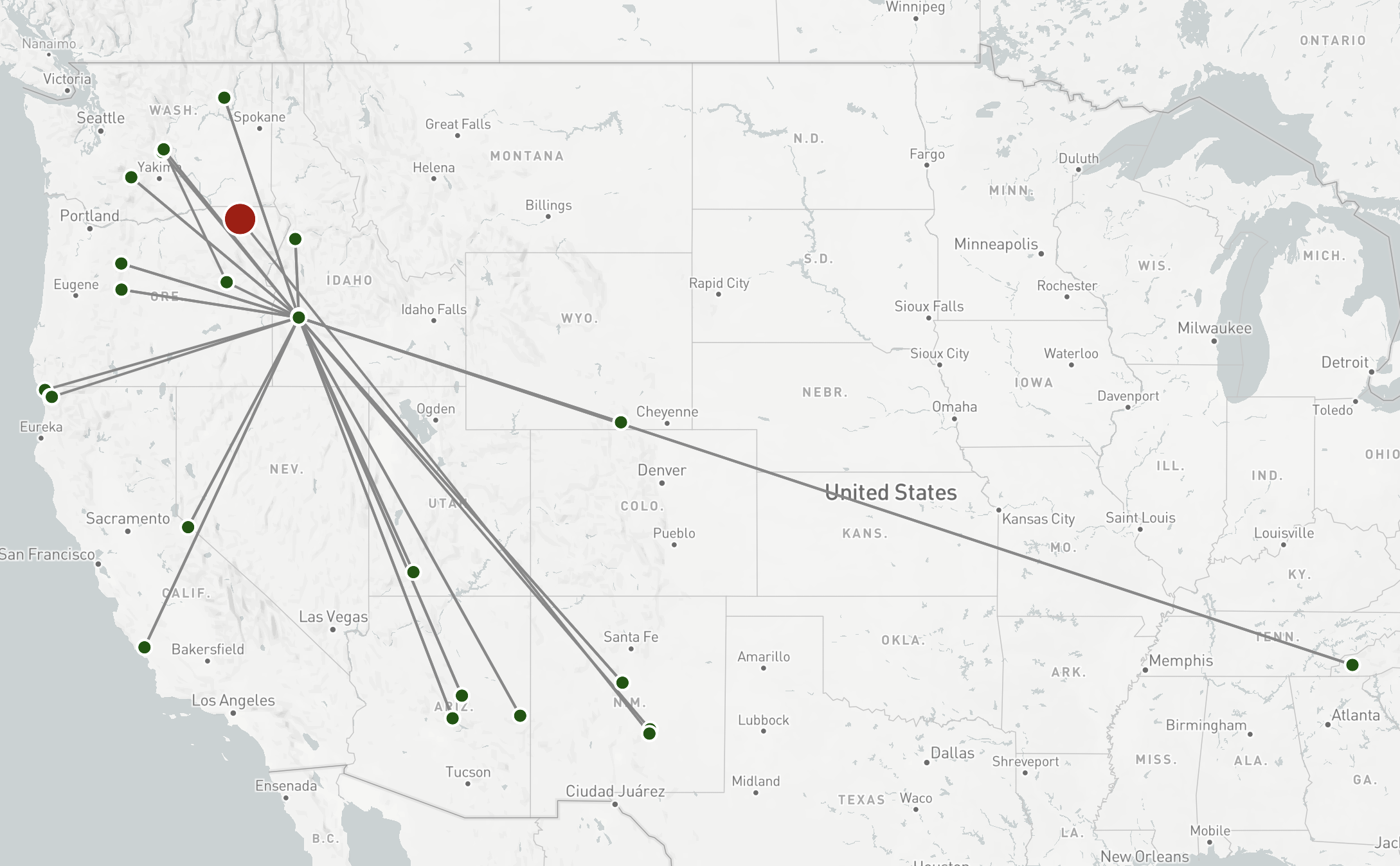
For example the USFS Remote Automated Weather Station (RAWS) system tracks stations by physical hardware. This is considered an essential factor in the processing of RAWS data. As a result, a single Synoptic station time series may include observations from multiple positions. Note that most RAWS sites move several times before being declared permanent; RAWS migrations often span hundreds of kilometers.
Privately held stations
Similar to above, stations owned privately will retain a single identifier, as this is associated with that piece of hardware and owner. When the individual relocates their site for whatever reason, the station will persist. All personal weather station networks demonstrate this to some extent.
Corrections and minor adjustments
Some sites are more-or-less permanently positioned, but will have “changes” occur due to improvements or corrections to metadata which may happen years after the fact. For example, most METAR sites are corrected over time, as the initial location established for a METAR site is more central to the airport indicated. As time evolves Synoptic is able to learn the more exact position of the site on the airfield, we will correct this information.
Similarly, some stations will receive minor changes, such as a METAR site moving to a different point in their host airport. Synoptic, following the policy noted above, does note the change in position, but does not create a new station. Maintenance and corrective changes tend to focus more on high-profile first-order networks, but can occur in any network.